Optimizely no longer wants to be seen as a digital experience platform. At Opticon London this week, it presented itself as an AI platform for marketing, with agents doing more of the work.
The Remarkable team was there. This year’s event was bigger than last year’s, and the programme was packed with client case studies showing Optimizely in action. Here are the six things we think matter most for Optimizely customers.
CMS 13 has been generally available since March 2026. It brings Visual Builder, Optimizely Graph and .NET 10 to PaaS customers, and Optimizely is adding to it quickly.
Recent additions include:
The bigger change is the agents. These include a Page Builder Agent, SEO and GEO agents, AI visibility analytics and a Figma Import Agent, which turns approved Figma designs into CMS pages built from existing components.
Due in H2 2026:
For customers, editors can build pages faster, and the journey from design to live page takes less developer time.
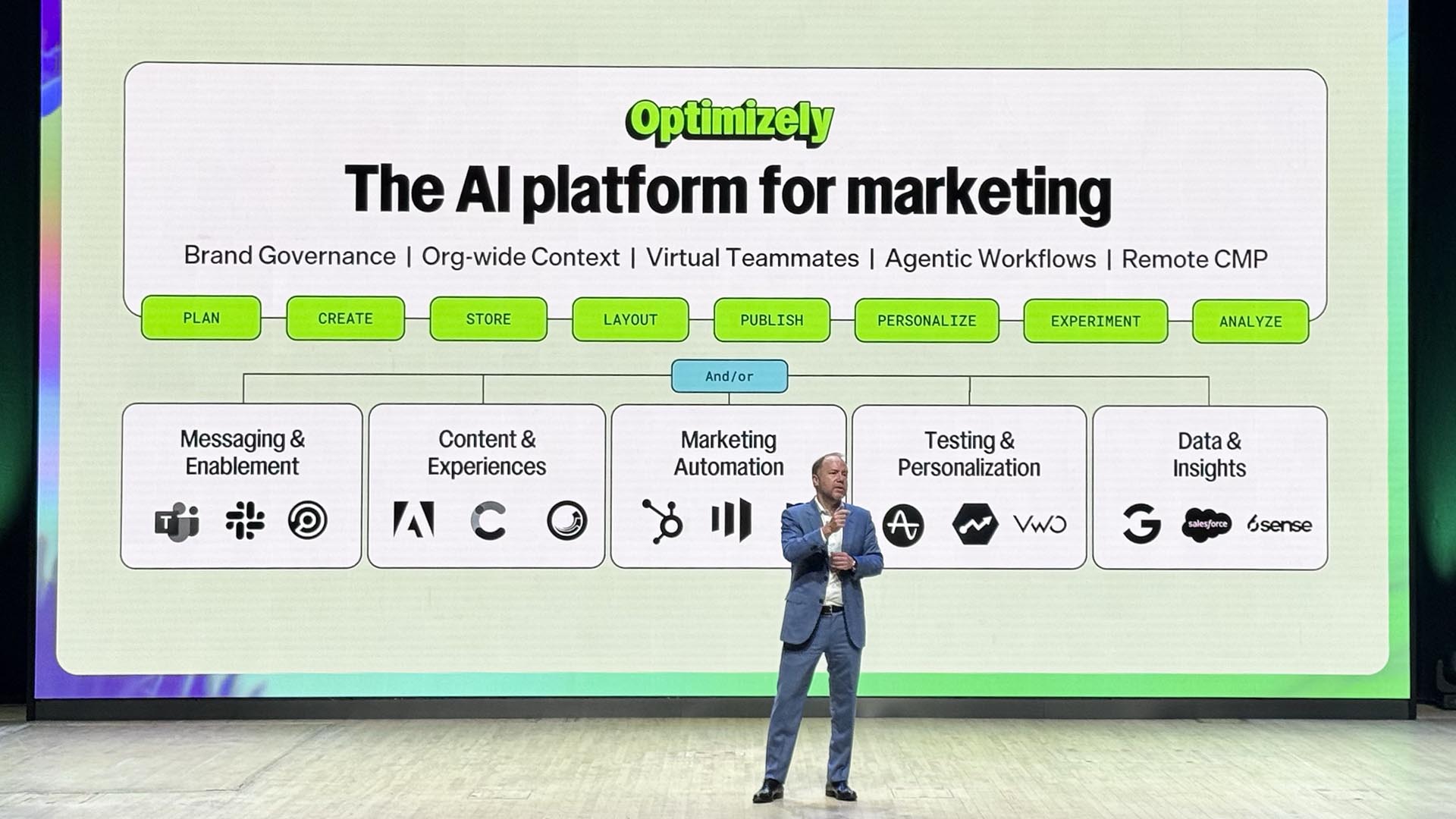
On 1 September, Opal was renamed the Optimizely Agent Platform, fronted by “Mark” (a nod to marketing). The new name signals the bigger shift: Optimizely is pitching itself as an AI platform for marketing, not a DXP. We’re already framing Optimizely conversations and roadmaps with clients this way.
Two features stood out.
Brand Packs hold a brand’s assets, colours, typefaces and usage rules in one place. You can create one with Mark from existing files, build it manually or import it as JSON. Once published, a Brand Pack becomes a skill that keeps generated images, Word documents and PowerPoint decks on brand. An organisation can hold several Brand Packs, with one set as the default, which suits multi-brand businesses.
Virtual Teammates are persistent AI workers with a set role, such as Marketing Analyst, Personalization Strategist, CRO Manager, SEO & AI Search Analyst or Chief of Staff. Each has its own Opti ID login and memory. It runs jobs on a schedule or when an event triggers them, and works with people and other teammates through Team Messages.
A Virtual Teammate only gets the access you grant it. By default it drafts work for a person to approve. Once you trust the results, you can let it act on its own for specific tasks.
The name echoes Salesforce’s talk of virtual co-workers. AI is now being sold as extra headcount, not tooling. That makes governance, onboarding and change management the real challenge: who sets a teammate’s role, what it can touch, and who checks its work. Most organisations will need help with this.
The bigger shift is to the marketing operating model. When AI moves from supporting individual tasks to running workflows and working across teams, organisations have to rethink how their teams work, where people need to step in, and how to govern an increasingly autonomous workforce.
Mark is backed by Mark-IQ, a context layer built on the client’s own data, and Mark-Bench, a benchmark for marketing tasks.
The competition is shifting from “which LLM?” to “which model knows marketing best?” One caveat: Mark-Bench is Optimizely’s own benchmark. Until there are independent comparisons, treat the performance claims with healthy scepticism.
Optimizely is offering itself as an end-to-end solution for answer engine optimisation (AEO): being found, cited and acted on by AI assistants, not just search engines.
| Capability | Status | What it does |
|---|---|---|
| AEO Analytics | Available now | Shows how a brand appears in LLM answers and what AI agents do on its site, combining server-log data with Conductor’s data on citations, mentions and search performance |
| AEO Agents | Available now | Find content gaps, benchmark AI share of voice against competitors and make changes, such as generating FAQ content with JSON-LD markup ready for the CMS |
| WebMCP | Open beta | Lets AI agents take actions on a website, such as booking a demo, so brands can capture demand that arrives through agents |
| AEO readiness score | H2 2026 | A score for how ready a site is for answer engines |
| AI traffic from your own CDN logs | H2 2026 | Analysis of AI traffic from your own CDN, not just Cloudflare |
On personalisation and account-based marketing, Limitless 1:1 Personalization uses agents to create a landing page for each target account or audience segment, drawing on CRM, CDP and ODP data. The pages are standard CMS pages on a subdomain, so search engines index them and they go through CMP approval. The agent updates a page when it spots a relevant change, such as a new executive hire or an acquisition.
AI is removing the content barrier to personalisation, moving beyond predefined segments towards experiences assembled for each person. That depends on structured, atomic content that AI can interpret and reuse. It also raises questions of brand control: the aim isn’t to make every experience fluid, but to let AI personalise within clearly defined boundaries.
The agents took centre stage. There was much less on the CMS, Commerce and DAM platforms that sit behind them.
That infrastructure still matters. It remains the system of record that agents build on, and it is what sets Optimizely apart from its SaaS-only competitors. Agents are only as good as the content models, components, data and approval workflows beneath them. Customers should keep investing in those foundations, even as the spotlight moves elsewhere.
Matt Ottignon’s keynote was a highlight for us. Its message: in a world filling up with AI-generated content, there’s no formula for standing out. It takes creativity, originality and a willingness to be braver.
As content gets easier to produce, a distinctive, recognisable brand becomes more valuable, not less. Great brands stand out and get chosen.
Optimizely is moving its focus towards the marketing operation itself, run increasingly by agents, and away from competing as just another experience vendor. For customers, the technology is arriving fast. The harder work is organisational.
The gap between what AI can do and what organisations are ready for is growing. Optimizely’s pace of innovation, especially around the Agent Platform, shows how fast the capabilities are moving. For most enterprise marketing teams, the challenge isn’t access to the technology but having the processes, governance and maturity to adopt it well.
This changes what clients need from partners like us. As platforms automate more of content creation, campaign execution and optimisation, the value shifts from implementation and delivery towards helping clients make the organisational and operational changes that turn AI into results.
Remarkable helps organisations plan, implement and govern Optimizely, from CMS 13 upgrades to rolling out agents safely. If you’d like to talk through what Opticon means for your roadmap, get in touch.
